


What It Really Costs to Underwrite a Loan In-House
The Cost of Origination, part one of seven.
Independent mortgage banks made more money per loan last quarter. Net production income came in at $973 a loan, up from $727 in Q1. Volume didn’t do that. Production expense fell to $10,936 per loan. The industry’s cost reduction is the entire gain.
So the industry is managing cost per loan. What most shops don’t have is a per-file cost for the two functions that touch every loan — underwriting and processing.
What the seat actually costs
Take a senior DE underwriter at a $95,000 base. That is a defensible market number — Salary.com’s median for the role as of August 2026.
Your underwriter doesn't cost $95,000. Add in: Payroll Load, Seat Cost and Supervision Share. All explained below.
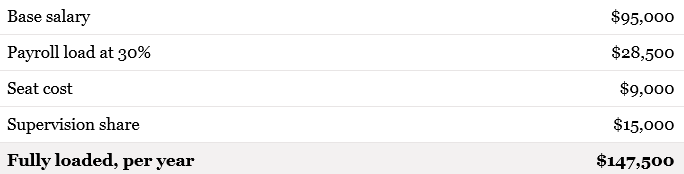
The payroll load is FICA, FUTA and SUTA, health, the 401(k) match and PTO accrual. Thirty percent is mid-range; most shops land between 25% and 40%.
Seat cost is the LOS license, the hardware, the AUS and verification tools, a share of E&O, and the square footage. Nine thousand a year is not aggressive.
Supervision is a share of the underwriting manager, assumed here at roughly one manager per eight underwriters. That role exists whether or not its cost is assigned to anyone.
Together these add 55% on top of the base — and they would add roughly the same 55% to any salaried professional at that grade, in any department. The multiplier is a fact about employment, not about underwriting.
What does an in-house underwriter cost per file?
A loaded annual cost tells you nothing until you divide it by output.
The most recent public throughput benchmark for retail underwriting is 19.2 files per month, from the 2018 MBA/STRATMOR peer group data. That is eight years old, and files have not gotten simpler since — non-QM, self-employment income, condo project review, the documentation load generally. We apply a 6% complexity haircut, which gives 18.05 files a month, or about 217 a year.
$147,500 ÷ 217 files = $681 per file.
Here is why the mistake is so easy to make. Divide the base salary by that same throughput and you get $439. The two calculations look identical on paper. They are $242 apart, and $242 × 217 files is exactly the load, the seat and the supervision — the three lines that never appear in the same report as throughput.
Two qualifications to keep in mind:
It assumes a full seat. One hundred percent utilization, no vacancy, no ramp, nobody out for three weeks. Run the same seat at 80% utilization and the file costs $851. That is a statement about pipeline volatility rather than about the person in the chair: capacity you have bought and cannot use gets charged against the files that do arrive.
It assumes a senior underwriter. An Underwriter I at $65,281 loads to $108,865, or $503 a file at the same throughput — and that comparison flatters the junior seat, because it holds capacity constant when in practice it is not.
Contract Underwriting
Contract underwriting in this market runs somewhere in the $350 to $500 range per file. Compared to $681, it is not a close call.
Run it on your own numbers
Four inputs, ten minutes:
1. Your payroll load rate. Not an industry figure. Ask accounting what benefits and employer taxes actually run as a percentage of base.
2. Your seat cost. LOS, AUS, verification tools, hardware, E&O, workspace. Annual total divided by headcount.
3. Your supervision ratio. Underwriters per manager, and what that manager costs (loaded).
4. Your real throughput. Cleared files per underwriter per month across a twelve-month window that includes your slow quarter.
The overhead assumptions above are planning estimates rather than anyone’s audited books, and the throughput benchmark is public data from 2018.
Have questions? Call or email me, and I’d be happy to run your numbers with you. I have the excel model ready to go.
Martin Luplow, AMP
(859) 977-9128
Next in the series: a senior loan processor earns a little more than half what a senior underwriter does. The file on their desk costs more. Part two runs this same arithmetic on processing, where throughput rather than salary is what moves the number — and where the gap between the two functions is wider than the org chart suggests.
The Commonwealth Group has provided contract underwriting, processing, QC and LOS administration to mortgage lenders since 2008. All services onshore.