What It Really Costs to Process a Loan In-House
The Cost of Origination.
A senior loan processor earns a little more than half what a senior underwriter earns. The file on their desk costs you more.
That runs against the intuition almost everyone brings to a staffing conversation, which is that the cheaper salary is the cheaper function. On a per-file basis it is the other way around.
What the seat costs
A senior loan processor at $53,178 — Salary.com and ZipRecruiter medians as of August 2026.
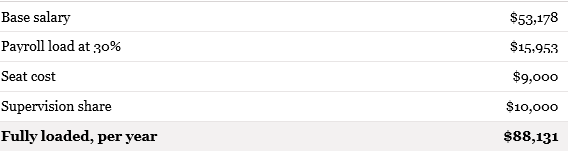
Same build as the underwriting post: a 30% payroll load, a $9,000 seat, and a share of the manager. Supervision is carried lower here, at $10,000, because processing managers generally run wider spans.
What does a loan processor cost per file?
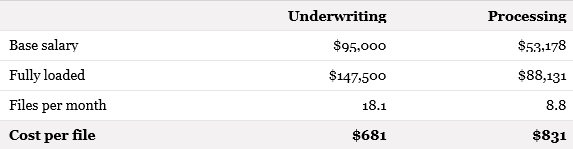
The most recent public throughput benchmark for retail processing is 9.4 files per month, from the 2018 MBA/STRATMOR peer group data. A 6% complexity haircut gives 8.8 a month, or about 106 a year.
$88,131 ÷ 106 files = $831 per file.
Divide the base salary alone by that same throughput and you get $502. The gap of roughly $330 a file is the load, the seat and the supervision.
Hiring cheaper does not close it. A Loan Processor I at $45,020 loads to $77,526, which is $731 a file — still above what the senior underwriter’s file costs.
Why the file production is half
The entire difference sits in the files-per-month row. Processing costs more per file because the same overhead spreads across half as many files, not because processors work less hard.
The two jobs have different shapes. In underwriting: the file arrives assembled, gets a concentrated decision, and goes back out. The processor holds the file from submission to closing, and most of those weeks are spent waiting on people nobody in your building controls — the appraiser, the title company, the employer, the borrower who has not sent the statement, the HOA that does not answer email. That time keeps the file open and the seat occupied without producing throughput.
What that number is standing next to
Contract processing runs in the $550 to $700 range per file, start to close.
The break-even is the more useful comparison. At the middle of that range, the annual cost of an in-house processing seat is covered at about 12.2 files a month.
A processor can clear 8.8.
Next in the series: those two throughput figures — 18.1 and 8.8 — imply a staffing ratio of just over two processors to every underwriter. Most shops are not staffed that way, and the ones that are not can usually tell you exactly where the files are piling up.