


What’s Really Driving Single-Family Home Affordability Off a Cliff in the US
For decades, owning a single-family home was the cornerstone of the American Dream. Today, for millions of Americans, especially younger ones, that dream feels more like a cruel joke. As of late 2025, the national median existing-home price hovers around $410,000–$420,000 (per NAR data), while median household income is roughly $81,000. That’s a price-to-income ratio of approximately 5.1, which is far above the historical “affordable” benchmark of 3.0 or lower.
So, what has happened? The affordability crisis isn’t the result of one villain: it’s a perfect storm of interlocking factors. Here are the biggest culprits.
1. Chronic Underbuilding Since the Great Recession
After the 2008 crash, single-family construction collapsed and never fully recovered. From 2009 to 2020, the U.S. built roughly 6.8 million fewer homes than long-term demographic trends would have required (Freddie Mac estimate). The deficit is now estimated at 3.8 to 7 million units depending on the methodology.
Result: We entered the 2020s with the lowest per-capita inventory of homes in decades, just 1.8 months of supply at the worst point in 2021–2022 (normal is 5 - 6 months).
2. The Lock-In Effect from Ultra-Low Mortgage Rates
About 82% of outstanding U.S. mortgages have rates below 5%, and roughly 60% are below 4% (Redfin, 2024). Homeowners with a 2.7 - 3.5% 30-year fixed rate have zero financial incentive to sell and buy something else at 6.5 - 7.5%.
This “rate lock-in” has removed millions of existing homes from the market, keeping resale inventory artificially low even as rates have started to ease slightly in 2025.
3. Excessive Regulation
After the housing crash of the Great Recession, government regulation at all levels, Federal, State, and Local simply exploded. Both the SAFE Act and the Dodd-Frank Act along with regulatory overreach (looking at you CFPB) have resulted in excessive regulation for lenders and have caused the cost of completing a loan transaction to sprint higher.
The SAFE Act and Dodd-Frank Act were already behind the times when launched and now are practically archaic. The restrictions placed on banks and lenders have strangled innovation in the industry as it relates both to financial products and to lender operations.
At a time when financial options are desperately needed, lenders are hampered by the regulatory environment and by rigorous enforcement actions.
4. Zoning and Land-Use Restrictions
Approximately 75% of the land in major metro areas is zoned exclusively for detached single-family homes- with lot-size minimums, setback rules, and parking requirements that make anything denser illegal (or financially impossible).
Cities like Austin, Seattle, Portland, and most California metros have effectively outlawed the “missing middle” (duplexes, triplexes, townhomes, small apartment buildings). The result: new supply trickles in at 1950s levels while population grows at 21st-century rates.
5. Institutional Investors and Corporate Buyers
From 2012 - 2022, investors purchased roughly 25 - 30% of low-price-tier homes in many Sun Belt markets (Redfin, ATTOM Data). Firms like Blackstone, Invitation Homes, and American Homes 4 Rent turned thousands of starter homes into single-family rentals (SFRs).
While investor activity has cooled since 2022 because of higher rates and lower yields, the homes they already own are largely off the for-sale market permanently.
6. Interest Rates: The 2022–2025 Shock
The 30-year fixed rate went from 2.7% in late 2020 to over 8% in October 2023, then settled in the 6.3 - 7.2% range through most of 2025. At 7%, the monthly payment on a $400k loan is roughly double what it was at 3%. Even with slight rate relief expected in 2026, the damage to purchasing power has been generational.
7. Demographic Pressure
4–5 million millennials are hitting prime first-time buyer age (30–40) every year
Record immigrant arrivals (legal and illegal) since 2021 added ~8–10 million new households competing for the same housing stock.
Rising divorce rates and “never-married” adults mean more single-person households needing separate units.
The Math in One Brutal Chart
Simply put, incomes have not kept pace with inflation during the last several years.
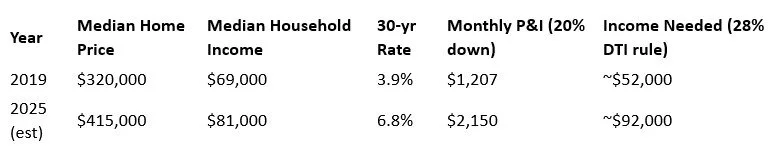
In six years, the income required to “afford” the median home rose ~77%, while actual median income rose only ~17%.
Is There Any Hope?
Hope springs eternal as they say, however, hope for housing affordability can best be seen in how long it will take to correct.
Short-term (1–3 years): The big issues here that could help are straight forward:
An Improvement in the regulatory requirement - Repeal or modification of the SAFE Act and Dodd-Frank would be a good place to start. Allow lenders to do what makes them money and allow financial and technological innovation assist..
Increased Inventory - Inventory is creeping up slowly as life events (death, divorce, job moves) force some locked-in owners to sell, but new construction remains stubbornly below 1 million single-family starts annually. With an improvement in regulatory requirements, additional resources and programs could be brought to bear along with expanded construction lending.
Sustained lower rates allowing more existing inventory onto the market.
Medium-term (5–10 years): Improvement will happen only if we see:
Aggressive zoning reform (already happening in Montana, California YIMBY bills, Florida’s Live Local Act, etc.)
Builders figuring out how to deliver smaller, cheaper homes on cheaper land (1000–1500 sq ft entry-level products)
Redevelopment of areas where the FHA 203k or the FNMA/FHLMC can be used to improve houses needing substantial rehab and allow banks to make construction loans in these areas for new housing. The infrastructure already exists, so lower costs to build could result.
Long-term (Over 10 years):
Demographics eventually roll over. The millennial peak buying wave ends around 2030–2032, and Gen Z is smaller. If supply can catch up by then, affordability could stabilize.
Control of the borders and less immigration (legal and illegal) would also be helpful.
Bottom Line
Single-family home affordability isn’t broken because of one policy or one event. It’s broken because for 15 years we built too little, zoned too restrictively, lent too cheaply (creating lock-in), and then slammed the brakes with rapid rate hikes. All of this while regulations, costs, investors, and population ran in the opposite direction.
Fixing it will require building a lot more housing, in a lot more places, a lot faster… and accepting that the 3% mortgage, 5,000 sq ft McMansion on a cul-de-sac for $250k was a one-time historical anomaly we’re not getting back.
Many companies are responding to the current lending and affordability environment by seeking out the professionals at The Commonwealth Group. Commonwealth has the expertise to guide your company, whether a bank, a credit union, or independent mortgage banker to achieve innovative and cost-saving solutions for their customers.
To get started and see what Commonwealth can do for your company, contact Martin Luplow at [email protected] for more information. The Commonwealth Group offers a variety of training, fulfillment, and consulting services for bank, credit unions, mortgage lenders, and mortgage brokers.
The Commonwealth Group is Innovative Services for the Mortgage Industry.
West Beibers, CMB, AMP, CRU
Chief Executive Officer
The Commonwealth Group Companies